
For healthcare professionals
Recurrence-risk evidence, in time for the treatment conversation
Results before the next appointment, from a test whose recurrence risk was assessed in patients receiving endocrine therapy without chemotherapy.
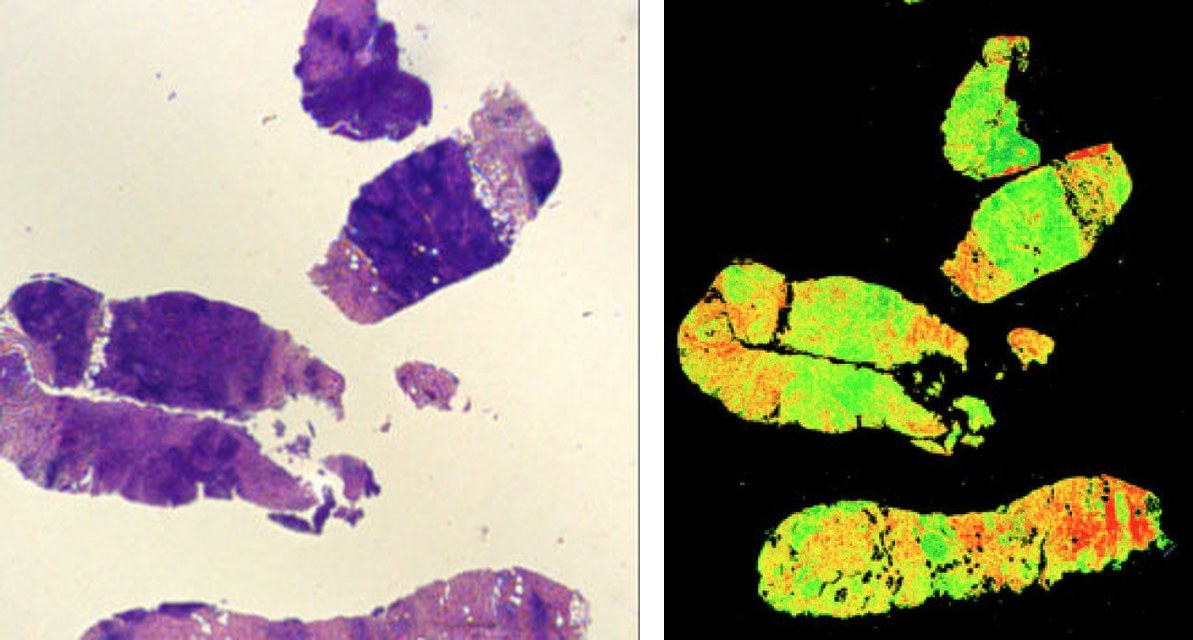
Left: a stained tissue section. Right: a Digistain mid-infrared chemical image.
At a glance
Two numbers that matter to this decision
Validation design
Who the evidence comes from
- 801 patients with HR-positive, HER2-negative breast cancer and 0–3 positive lymph nodes.
- Treated with endocrine therapy alone (tamoxifen; goserelin for some premenopausal patients). No adjuvant or neoadjuvant chemotherapy.
- Median follow-up of 12.7 years in the validation cohort.
- Peer-reviewed: Coombes et al., Breast Cancer Research and Treatment 2024;205:349–358.
Published performance
Figures with study, population and endpoint
| Measure | Result | Endpoint and timepoint |
|---|---|---|
| AUC | 0.81 | Recurrence-free survival and recurrence, 5 years |
| AUC | 0.75 | Recurrence-free survival and recurrence, 10 years |
| Negative predictive value | 0.96–0.99 | 5 years |
| Negative predictive value | 0.84–0.95 | 10 years |
| Hazard ratio, low vs high risk | 1.80 | Recurrence-free survival |
Study: Digistain Prognostic Score validation, ESMO Breast 2023 abstract and Coombes et al., Breast Cancer Research and Treatment 2024;205:349–358. Population: 801 patients with HR-positive, HER2-negative breast cancer, 0–3 positive nodes, treated with endocrine therapy without chemotherapy. Positive predictive value is low (0.02–0.09 at 5 years), as expected for a rule-out test.
Recurrence-free survival by Digistain risk group
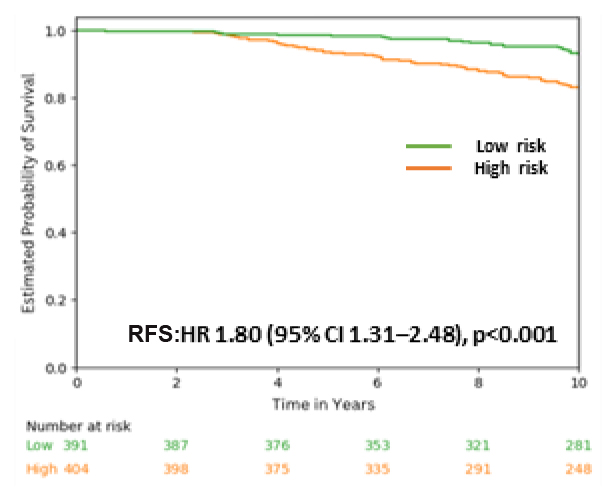
Kaplan–Meier curves of recurrence-free survival for patients classified low risk and high risk by Digistain in the 801-patient validation cohort. Hazard ratio 1.80 (95% CI 1.31–2.48), p<0.001.
Source: Coombes et al., Breast Cancer Research and Treatment 2024;205:349–358. Patients treated with endocrine therapy without chemotherapy; retrospective, single-centre cohort.
Limitations
What the study does not show
- Retrospective, single centre: Nottingham City Hospital, patients treated 1998–2006; the authors note this is somewhat atypical of a contemporary population.
- Validation used K-fold cross-validation within the same institution, not an independent external cohort. Multicentre studies are reported as in progress.
- Low-risk cohort by design: 90% had no recurrence within 10 years.
- The authors conclude performance is similar to that reported for other risk tools.
- Declared interest: Hemmel Amrania and Chris Phillips are Digistain’s CEO and CSO.
Turnaround
When results arrive, by delivery route
Run in your local laboratory
Results usually within one to two days of the sample reaching the laboratory.
Digistain’s laboratory service
Usually three to four days including shipping, depending on courier and customs.
Turnaround in your market: [DELIVERY ROUTE PER MARKET]
Evidence briefing
See the evidence for yourself
Request a briefing on the validation study, its limitations and how the test is delivered in your market.
Regulatory status and intended use
Intended use. Digistain Breast is in vitro diagnostic software that gives a quantitative prognostic score for risk of recurrence and recurrence-free survival at 5 and 10 years. It is used as a categorical (High/Low) prognostic indicator alongside other clinicopathological factors in pre- and post-menopausal women with HR-positive (ER+ and/or PR+), HER2-negative, stage I–II invasive breast cancer with 0–3 positive lymph nodes, treated with adjuvant endocrine therapy alone. It is not intended for diagnosis, for predicting response to therapy or for selecting therapy, and it is not a companion diagnostic. For use by trained laboratory personnel in a clinical laboratory, on surgical resection FFPE sections. Core biopsies are not suitable.
United Kingdom: UKCA-marked (self-declared), CE-marked under the IVDD, and registered with the MHRA.
European Union: CE-marked under the IVDD. IVDR Class C conformity assessment in progress with notified body QMD Services (2962).
United States: Not currently available in the US.
Other markets: [STATUS PER MARKET]
ISO 13485:2016 certified (LRQA) for the design and development of IVD software used in cancer management.